The primary goal of this course to introduce UW students to India’s environmental policies pertaining to conservation and development. Through lectures, discussions and individual research, students will gain insights about how these policies were developed, put in place, and their outcomes.

This blog site highlights student accomplishments and travel experiences to India.


Wednesday, September 25, 2019

Living on Indian Time: Coimbatore, India

By: Emma Dixon
July 2019 Trip to Coimbatore, India

Two weeks is a short time to try and immerse yourself into a new culture. This was the challenge I had coming to Coimbatore.


We stayed at the Coimbatore Campus of Amrita University, where I had the opportunity to meet faculty and befriend several graduate students. The campus was nestled between lush mountains and had some of the most beautiful, manicured gardens I had ever seen. Wandering the expansive grounds or taking in the view from the guest house roof was always a good way to start or end the day.

While two weeks exploring the Amrita campus and surrounding area was not much, it proved ample time to learn several important lessons.


Lesson one: Flexibility.

We think that we are flexible in the United States but being willing to reschedule and change plans still requires having a rigid plan in the first place. The first several days, I most likely asked Ramesh what the plan for the upcoming day was several times.

While we would make a tentative working plan for the upcoming day, it was subject to change depending on variables out of our control. The feeling of not having an idea of what will happen made me uncomfortable. It went against everything I had learned in the United States.
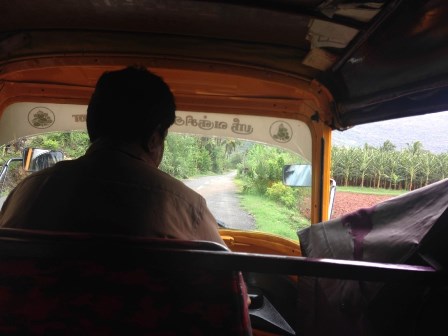
The view from the back of the first
auto rickshaw I have ever ridden in
Nonetheless, there is a lot to be said for not always having a rigid schedule. Being open to spontaneous opportunities and viewing time as a bendable concept instead of a rigid one allows you to participate in experiences you never dreamed of.

Not getting the taxi you planned on leads to an amazing trip in an autorickshaw (an open-air motorized vehicle with three wheels).

Randomly stopping to talk with a shop owner or farmer prompts an invitation to have tea or tender coconut in their home.

If I had been back in the United States, I doubt that I would have been able to say yes to all of these opportunities, or if they would have even been offered in the first place.


Roast - a dish made from a paste of rice and lenti
at one of the three Amrita University cafeterias. Delicious!
Lesson two: Hospitality

Many people in the United States would not think to invite in a stranger they have talked to for twenty minutes for tea and food, but the hospitality and kindness of many people in India run deep.

I am so grateful for the many people I met and the myriad of ways they showed little acts of kindness. Whether it be making sure I ate good food, giving me a flower or making tea, they showed that they cared.


Lesson three: Spicy vs. Hot

Puttu, a dish that consisted of rice rolled in coconut
& kdalai curry, a side dish made with beans and spices

Many of the dishes I got to try were heavy on green chili and whole black peppercorn which challenged my spice tolerance, or heat tolerance, as I should say. 

While I was there, I learned that spicy food means food rich in a variety of spices, not hot, which is the correct terminology for food that sets your mouth on fire.


Overall, I am looking forward to returning to Coimbatore sometime within the next year or two so that I can learn even more of the culture and human elephant conflict occurring there.

Thursday, August 22, 2019

Competition for Resources between Humans and Elephants: Lessons Learned from Coimbatore, India

By: Emma Dixon
July 2019 Trip to Coimbatore, India

Born and raised in Kansas, the breadbasket of the United States, where the main pests’ farmers worry about are insects, rodents and birds, I could never have imagined researching human elephant conflict.

 A coconut farm in Coimbatore, Tamil Nadu, India. It takes more than 20 years for the coconut trees to reach this height and provide consistent yield. Several trees can be damaged in during an elephant raid.

Human elephant conflict (HEC) is the competition for shared resources that is mainly a result of the fragmentation and degradation of the Asian elephant’s habitat. This can often lead to a lack of food, water and space for the elephants.

India, home to a majority of Asian elephant population, witnesses several HEC incidents annually that results in both human and elephant casualties.

An employee at the local temple describes how elephants
access the water in the tank. This footprint was left
by an elephant only few hours before we visited this temple.
The farmers in and around Coimbatore, a city in Southern India has taken the brunt of the consequences as elephants commonly raid certain crops like coconut, plantain, sorghum, maize (corn), and areca nut for food, and other cash crops trampled.

Having their crops eaten by elephants causes great economic damage to the farmers who rely on their crops to support their families.

By talking to the farmers and villagers impacted by HEC and seeing the physical barriers they have built to protect their crops and properties, my understanding of this multidimensional issue grew.

There are so many different stakeholder viewpoints, some of the farmers viewing the elephant with understanding/respect and others with fear/dislike.

Learning more of the factors that have created this problem and could lead to its solution will take time, but I know that everything I learn through this project can be used on future issues that require an interdisciplinary solution.

With the villagers who described their experiences with elephant raids.

I plan to visit this area in near future and collect more data to further my understanding of this problem.  My future research and subsequent publications will allow the scientists and policymakers working on solutions to HEC to understand the issue in greater depth.

Tuesday, August 14, 2018

Human-Elephant Conflicts: A graduate student’s experiences in India

By: A. Nicole Reed
July-August 2017 Trip to Coimbatore, India

As I stepped off the plane in Coimbatore, India, I never imagined it would change my perceptions of the world any more than it had three years ago. This would be my second time in India and I thought I knew what to expect. Everything from the food and smells to what local farmers were experiencing on their land. However, each day was a new experience filled with new information and lessons learned.

Collecting stakeholders input on human-elephant conflict
in Coimbatore, Tamil Nadu, India (August 2018)
This trip was for collecting data on people’s experiences and opinions about elephants raiding crop fields in and around Coimbatore District which will be part of my master’s thesis project. I traveled to small villages near and away from the forested areas and spoke to farmers about the conflicts they were experiencing with elephants. I visited these villages with my thesis adviser and faculty members from two colleges in Coimbatore. We interviewed about 100 farmers and other stakeholders and learned the difficulties they face to protect their crops and make a living. I also learned which mitigation efforts are more effective than others.

With students, staff and faculty at Kongunadu A&S College, Coimbatore (August 2018)
I stayed at two different colleges and met many people of different backgrounds and was fortunate to take part in a river festival with one of the college official’s families. This experience helped me better understand the culture in India and allowed me to make lasting relationships with many.


There were several opportunities for myself as well as my project to develop further, perhaps though, my biggest take away from this trip was the need for communication among professionals across disciplines as well as internationally. I was also asked to present on wildlife and land management in the United States. The exchange of information available could help us work toward solving global issues such as human-wildlife conflicts. This type of communication would allow each of us to learn from each other quickly and create better, well informed, decisions. Overall, my time spent in India was useful on several levels and allowed me to collect my data as well as learn more about the culture and history of the area. 

Saturday, April 28, 2018

Is genetically modified cotton responsible for the economic hardships faced by farmers in Central India?

William Baxter, Celia Karim, and Bryan McInerney presented their research on the genetically modified Bt cotton and its possible links to economic hardships faced by farmers in Central India. 


Protecting crops from pest infestation and diseases is one way to increase to reduce losses.  Genetically modified crops are promoted as one of the ways to increase crop yield by protecting them against pest attacks.

Bt cotton, a GM crop, was developed by introducing a toxic gene from a bacterium (Bacillus thuringiensis) into cotton plants to build resistance against the pink bollworm (Pectinophora gossypiella), a major pest of this crop.

Bt cotton was marketed in India with hopes of higher yield and lower input cost.  However, the farmers did not understand that Bt cotton was susceptible to other pests and drought, which resulted in unexpected outcome.

Their presentation focused on the introduced of Bt cotton in India and its impact on the lives of farmers in Central India.

Friday, November 10, 2017

Impact of Prosopis Juliflora on the environment

By Andrea Weber
August 2017 trip to Coimbatore, India

In Spring 2017, I began my research journey with writing a literature review from newspaper and journal articles about an invasive tree species, Prosopis juliflora, known as seema karuvelai, in Tamil Nadu, India. I was fortunate enough to have the opportunity to travel to India in Summer 2017. My trip to India was amazing and exciting, but is hard to describe in more words. We stayed in a women’s hostel at a co-ed university. The girls were amazing and caring. They made us feel right at home, and shared their research journeys with us.

P. juliflora tree with ripe seed pods growing near Sulur Lake, Coimbatore, India.
While in India, my focus was to discuss an invasive species, Prosopis juliflora with the people, to really understand the impacts it has on the wildlife and humans. After talking with people from many settings, rural, city, mountain, scholarly, I was able to gather enough information to understand this tree from the ground, from the people using it and living with it.

A woman cutting juliflora tree for domestic fuel wood.

In terms of the work we conducted, I learned that knowing people within the field you are researching is extremely important. Things are not always laid out nicely, like they are in a lab manual. If you need information about a certain species of tree that is growing in the area, it is important to gather information from people who have studied it, and people that have lived with it. I learned that it can be difficult to communicate with people who don’t speak the same language, and that sometimes questions need to be worded or approached differently.

Andrea Weber (left) and Mackensie Swift in a restaurant in Coimbatore, India
The information that I gathered from goat farmers, cow farmers, medicine men, and university scholars, were similar, in comparison to what the government newspapers were stating. Through this experience, I am much more aware of the challenges that research presents, such as working around obstacles in the field and with communication.

Saturday, April 29, 2017

Savannah Hook and Ishan Patel presented their research on Zero Liquid Discharge

Savannah Hook and Ishan Patel reviewed the impact of Zero Liquid Discharge (ZLD) Policy on the textile industries and the environment in Tirupur, India.


ZLD required bleaching and dyeing units in and around Tirupur to treat their effluents before discharing them into the environment. They presented the current water quality issues of Noyal River after ZLD was enforced in 2011.

Tuesday, August 23, 2016

Experiences of a U.S. Science Educator in Coimbatore, India

By Sarah 'Katie' Guffey 
July-August 2016 trip to Coimbatore, India

With the population in the United States rapidly changing, it’s helpful for US teachers to understand educational systems throughout the world. Traveling to India allowed me to experience their educational system first hand. Perhaps surprisingly, our schools systems have many commonalities, including the types of schools, subjects offered, and teacher training programs.

While in Coimbatore (a city in Tamil Nadu state), I was able to witness the K-12 system and observe the primary school teachers. Overall, the education system in India and the US are quite similar. Primary schools in India (kindergarten & standards 1 through 5) are equivalent to US elementary schools (grades K-5). Similar to the US public, charter, and private schools, India has various types of K-12 schools including State Government Board, Central Board of Secondary Education (CBSE), among others.

Tamil Nadu State Board schools use a card system to keep track of academic milestones. Teachers use this and supplemental materials as a curriculum guide.

There are Tamil medium schools where all subjects are taught in Tamil and English medium schools where subjects are taught in English.

The first school I visited was a Tamil medium school that was following the Tamil Nadu State Board curriculum. All students will enroll in an English language course however, but rest of the subjects were taught in Tamil.


The majority of students were from a low socioeconomic background. The teachers will have roughly 35-45 students in each class. There was no cafeteria on the school grounds so most students pack their lunch. Similar to the US, if a student’s family falls within a certain socioeconomic status, lunch is provided by the government each day.

On average, only 3 to 4 students miss school each day and it is the student and teacher’s responsibility to make up missed work and instruction. The card system allows the teacher to know exactly where the student was academically before he/she missed school.

The second teacher was from a CBSE, English medium school. All subjects were taught in English with students given the option to take an additional language (Hindu, Tamil, French, etc.). The majority of students are from a middle, socioeconomic background. Generally, teachers will have between 25-35 students in each class. This school differs from the state board school in that the students have access to computers. This allows the teacher to implement the use of a class website. In addition to the card system, students also have a textbook and a workbook. On average, 1-2 students miss class each day however, most teachers will receive notification from the parent if the child is planning to miss school. Individual instruction will be provided during the child’s physical education class to make up for missed classwork.


Visiting these classrooms and talking to teachers allowed to interact with many talented teachers and gain valuable insights that will help me to teach an ever-changing student population in the US.