By: Dylan Sollenberger
July 2019 Trip to Coimbatore, India
At a Hindu temple near my hometown of Peoria, Illinois, I once asked a man who spent half his life in India and half in the United States, what the difference was between people from both areas. With a big smile on his face, he explained to me that the difference between people is like an onion. Sounds odd, but like the layers of an onion, superficial differences can be peeled away till there is nothing there. No real difference at all. I understood what the man was saying but until my travels to Coimbatore, India I couldn’t capture the full scope of his wisdom.
Before any mention of the trip, I had always wanted to travel to India. My exploration into Eastern Philosophy had greatly intrigued me back home. Upon moving to Laramie, Wyoming to continue my education, I was curious to see how my academia and spiritual endeavors would intersect. I was elated when I found there was an Environmental Policy in India course offered in the spring. My main research project for that course focused on environmental action taken on behalf of spiritual communities near important religious sites. What began as a case study on specific environmental/religious initiatives broadened into an overall study in the relationship between spirituality and biological conservation. When my teacher asked if I would like to travel to India to further explore this theme as part of an elective course I couldn’t refuse. What seemed to be separate roads of academic pursuit and spiritual journey were now appearing to be as one.
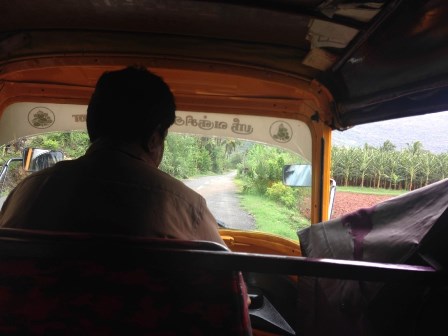
After never thinking I would get out of a plane seat or an airport, I finally arrived in Coimbatore, India. I must admit, it was a lot to take in at first. I had never traveled outside of the United States. I’ve barely ever flown before. Now I’m trying to buy food that I can’t pronounce with money I’ve never seen. Not to mention, I have a hard time understanding solely English-speaking people. Let alone a country where there are many different dialects and accents (you quickly realize the limits of only being taught one language). The traffic, oh my goodness. It seemed to be as if there were more guidelines than actual rules when it came to the road. Sort of a free-for-all, which to people from this area was completely normal. They seemed to navigate the roads almost flawlessly without any conflict. Before getting overwhelmed, I reminded myself of what the man back home said. “Superficial differences”.
Once we got to Amrita University where we were staying, I remember having the overwhelming feeling that I made the right decision coming on this trip. The University was basically located in the middle of the jungle next to these beautiful mountains. It was as if the buildings were part of the nature there, like the grass and the trees. In many highly developed areas you get a feeling of the development choking out nature, but here it all seemed to be perfectly integrated. Walking around campus didn’t feel like a stressed time crunch to get to class, but rather a meditative walk through the forest. Which is another thing. Almost everyone here seemed to walk at a much more relaxed state. I remember on one of my early walks with a good friend I made by the name of Shashank, having to constantly remind myself to slow down. The plants and abundant wildlife on campus really seemed to facilitate this idea of soaking in the little things while going about your daily life. I had yet to meet my spiritual teachers who along with Shashank and a few other amazing students, would be the strongest aid to my research; but I was already beginning to understand the links between spirituality and nature.
Something I was not aware of before coming on the trip, was just how grounded in spirituality Amrita University truly is. I knew it would be tied to Eastern Philosophy, especially Hinduism, but not on the level I discovered. Founded by the renown spiritual leader, Amma (Mother), Amrita University focuses on blending tradition and materialism. Amma, who I’ve come to appreciate on a monumental scale, believes that the University is like a tree that should be rooted in spirituality and branched in materialism. Instead of thinking of the two as separate, think of them as one that must rely on the other for wholesome survival. She also has the quote that is on all the buses at Amrita University saying, “Love is my Religion”. If there is any way I could explain the power of Amma this quote would be it. Her presence and words have the ability to offer spiritual sanctity to many across the world, and I was beginning to understand why.
Another vital spiritual leader that helped with my research was a man whom I called Swamiji. Swamiji is Sanskrit for “he who is one with his self” and is usually termed for an ascetic or yogi who has been initiated into a religious monastic order. He oversaw the spiritual practices and offered spiritual advice to students on campus.
Upon meeting him, I was immediately taken back by his kindness and wisdom. He was the one who really laid the framework for the connections into spirituality and conservation that I was exploring here at Coimbatore. He would explain concepts to me that would range from the universal core of all religions to the art of meditation. He was able to elaborate on Eastern concepts that I briefly learned in Illinois but didn’t fully understand. He strongly believed that the core of all religions remains the same, and that there are only superficial differences that give off the false perception of difference. The man and his onion story from back home was now ever so clear.
Whether spending my days studying the different plant and animal species near campus or learning from spiritual gurus who taught insight into the appreciation of these lifeforms, my research was coming along great. I was really starting to understand how having a certain view spiritually can affect how you treat other living organisms and subsequently acts of biological conservation. I was also receiving enormous help from many students on campus, whom I now considered good friends. Which is another important thing to note. I don’t think I met one rude person during my stay in Coimbatore! It was my birthday on one of the last days and the students even threw me a surprise birthday party!
All the different help I received, the man who probably helped me the most was Bill. Bill is an interesting fellow who was introduced to me by Swamiji. He is from California and although he isn’t originally from the Coimbatore area, he understood the mysteries of the universe better than anyone I met. I won’t get too much into Bill as I believe he would prefer the ambiguity as well as I’ve already rambled on too long for this blog (I could talk about India forever). Let’s just say he was a true guru to me during my stay and the spiritual knowledge I gained from him could never be put into words. He helped me find who I was, which in turn had the most substantial effect on my research. I was now looking at this new and different place I was in but no longer seeing a difference. The traffic, buildings, animals, languages, people, all which seemed like crazy differences, were now like the superficial layers of the onion and not actually real to me. Just like the previous perception of myself, which allowed superficial differences to dictate that I was something different than everything around me, I could now understand the concept of universal oneness. The main concept my research was now based upon. Without my trip to India none of this could have happened. I would never have had the opportunity to do research on such an important subject and my own personal spiritual would never had been jump started in such a way that continues to push me today.
July 2019 Trip to Coimbatore, India
At a Hindu temple near my hometown of Peoria, Illinois, I once asked a man who spent half his life in India and half in the United States, what the difference was between people from both areas. With a big smile on his face, he explained to me that the difference between people is like an onion. Sounds odd, but like the layers of an onion, superficial differences can be peeled away till there is nothing there. No real difference at all. I understood what the man was saying but until my travels to Coimbatore, India I couldn’t capture the full scope of his wisdom.
Before any mention of the trip, I had always wanted to travel to India. My exploration into Eastern Philosophy had greatly intrigued me back home. Upon moving to Laramie, Wyoming to continue my education, I was curious to see how my academia and spiritual endeavors would intersect. I was elated when I found there was an Environmental Policy in India course offered in the spring. My main research project for that course focused on environmental action taken on behalf of spiritual communities near important religious sites. What began as a case study on specific environmental/religious initiatives broadened into an overall study in the relationship between spirituality and biological conservation. When my teacher asked if I would like to travel to India to further explore this theme as part of an elective course I couldn’t refuse. What seemed to be separate roads of academic pursuit and spiritual journey were now appearing to be as one.
 |
| After landing in New Delhi International Airport with fellow student Emma Dixon and Ramesh Sivanpillai (Instructor) |
Once we got to Amrita University where we were staying, I remember having the overwhelming feeling that I made the right decision coming on this trip. The University was basically located in the middle of the jungle next to these beautiful mountains. It was as if the buildings were part of the nature there, like the grass and the trees. In many highly developed areas you get a feeling of the development choking out nature, but here it all seemed to be perfectly integrated. Walking around campus didn’t feel like a stressed time crunch to get to class, but rather a meditative walk through the forest. Which is another thing. Almost everyone here seemed to walk at a much more relaxed state. I remember on one of my early walks with a good friend I made by the name of Shashank, having to constantly remind myself to slow down. The plants and abundant wildlife on campus really seemed to facilitate this idea of soaking in the little things while going about your daily life. I had yet to meet my spiritual teachers who along with Shashank and a few other amazing students, would be the strongest aid to my research; but I was already beginning to understand the links between spirituality and nature.
 |
| Combining conservation and spirituality: Temple under trees |
 |
| An evening stroll |
Upon meeting him, I was immediately taken back by his kindness and wisdom. He was the one who really laid the framework for the connections into spirituality and conservation that I was exploring here at Coimbatore. He would explain concepts to me that would range from the universal core of all religions to the art of meditation. He was able to elaborate on Eastern concepts that I briefly learned in Illinois but didn’t fully understand. He strongly believed that the core of all religions remains the same, and that there are only superficial differences that give off the false perception of difference. The man and his onion story from back home was now ever so clear.
Whether spending my days studying the different plant and animal species near campus or learning from spiritual gurus who taught insight into the appreciation of these lifeforms, my research was coming along great. I was really starting to understand how having a certain view spiritually can affect how you treat other living organisms and subsequently acts of biological conservation. I was also receiving enormous help from many students on campus, whom I now considered good friends. Which is another important thing to note. I don’t think I met one rude person during my stay in Coimbatore! It was my birthday on one of the last days and the students even threw me a surprise birthday party!
 |
| Surprise (Happy) birthday party hosted by Amrita's Center for Computational & Engineering Network (CEN) students |