The primary goal of this course to introduce UW students to India’s environmental policies pertaining to conservation and development. Through lectures, discussions and individual research, students will gain insights about how these policies were developed, put in place, and their outcomes.

This blog site highlights student accomplishments and travel experiences to India.


Tuesday, April 21, 2020

Thoughts on the UCC’s reaction to the Bhopal Gas Tragedy

By: Nicole M. Miller
April 2020 - Reflections on Bhopal Gas Tragedy

My original thoughts after learning about the gas tragedy of Bhopal, were shameful towards the American company who placed their plant in an unfit workplace. From a realist perspective in terms of capitalism, it is understandable why they put a plant in Bhopal. Bhopal is in central India, so the location is prime. Also, it is much cheaper to employ workers in India then in the United States. However, safety precautions should never be ignored. These precautions were blatantly ignored because it was cheaper to do so. They also did not consider that in the area, the public heath infrastructure was poor and even something as simple as tap water was only available a few hours of the day [1].

The night before the accident, there was a small leak of MIC and pressure was increasing in the storage tank and the vent gas scrubber (that neutralizes toxic discharge) was turned off for three weeks. Not only that but, the refrigeration unit was also shut off, so pressure and heat continued to build up in the tank, and the gas flare safety system was also shut off for three months. After I learned about this, I understood that it was out of money saving tendencies as to why the safety precautions were shut off and ignored. According to Broughton (2005), “the facility continued to operate with safety equipment and procedures far below the standards found in its sister plant in Institute, West Virginia” [1]. This was because local workers were instructed to prepare the plant for selling (due to lack of profit), but no one would purchase it.

The reason why the safety precautions were ignored was the company was performing bad in terms of finance so they could not afford to keep them up and running. I believe that if money was the issue, they should have stopped production all together instead of continuing production and just simply ignoring safety precautions. However, the city of Bhopal had to suffer the consequences, which is simply not fair. India and the United States had business treaties in which were guaranteed but violated in Bhopal [2]. It is important to try to look at tragedies like these as warnings in order to prevent it from happening again. This event could have been a hard lesson learned for the UCC, however it appeared to me that they tried to ignore the problem rather than learn from it. They took no responsibility and they withheld information from the public. The entire process was delayed because the case went back and forth between courts of India and the United States. To this date, there is no released information on what was exactly leaked from the factory in December [1].

A section of the UCC plant (Bhopal, India) several decades after the disaster
(Source: Simone.lippi at it.wikipedia / CC BY-SA (https://creativecommons.org/licenses/by-sa/2.0)


A survivor-activist Rashida Bi summarized his opinion on the situation in Bhopal by stating, “Those who died while asleep on Dec 2, 1984, were lucky. Those who survived are dying bit by bit every day. We are being treated as if we are culprits” [2]. Overall, I believe that the UCC is to blame for this tragedy. It is a hard lesson learnt and justice has yet to be served. The path of industrialization (especially in developing countries) is a difficult path. By this I mean, businesses have to make sacrifices and learn from mistakes. This tragedy can be looked at as insight gained in terms of not letting something like this happen again.

Sources:

[1] Broughton E. (2005) “The Bhopal disaster and its aftermath: a review.” Environmental Health, 4 (6). DOI: 10.1186/1476-069X-4-6 Link

[2] Sharma, D.C. (2005) “Bhopal 20 Years On” The Lancet, 08 January 2005 Link

Wednesday, April 15, 2020

Bhopal Gas Tragedy Response: A Photographer’s View of the Tragedy

By: Alannah C Gee
April 2020 - Reflections on Bhopal Gas Tragedy

Seeing the world through a camera can distance a photographer from the pain they are capturing. In the moment, we can hide behind our industrial box, perfectly designed for capturing and sharing moments. We try to hide, try to throw ourselves into the process of creation.
Bhopal Gas Tragedy
Background information
NBC News Report (1984)
The Economist's Review (2014)
No amount of mechanical distance could allow photographers to hide from the pain of their subject on December 3rd, 1984. Tragedies often do this; overwhelming pain surrounding the camera seeps through the lens and infuses photographs with the deep sorrow felt by the people affected by them. The gas leak in Bhopal was one such pain infused tragedy and photographs resulting from the aftermath hold such deep heartfelt pain, even today.

On the morning of December 3rd, photographers arrived in the city of Bhopal India, one of the most notable being Raghu Rai, ready to walk among the people whose lungs had accumulated pieces of the massive, around 40 ton, cloud of toxic gases released from a neglected, unsafe pesticide plant the night before [1]. What these photographers witnessed and captured gave a visual face to the harsh neglect of the large industrial company responsible for the leak, Union Carbide. These photographs are hard to even look at and must have been much harder to take as they capture scenes of children being buried and husbands carrying their dead wives across the now desolate city [2]. They also captured victims of the tragedy, suffering from injuries like blindness. One powerful image taken by Rai shows the Union Carbide plant surrounded by lingering gas and shows the proximity of the lower caste housing whose residents were all greatly affected by this gas leak. The photographs by Rai go on to chronicle the processes of cremation and later entire bags full of skulls [2]. He shows just a piece of the immensity of this tragedy but yet is able to so directly capture the gut-wrenching pain in fixed images.

Source: https://bit.ly/2FUiaOv

It is hard to imagine what being a photographer in this tragedy would have been like, but I imagine it would have been strikingly similar to ones capturing other historical tragedies enshrouded in human based pain, like 911 or various wars. Rai’s photographs give me a strikingly similar feel as the ones taken in the Vietnam War of children running naked away from napalm bombs [3]. The intentionality of these situations is vastly different, but both involve helpless citizens running from pain that is descending from the sky, running from poison threatening to fill their lungs and bring them to their knees or even their graves.

Walking through the streets of the areas around this plant in the days after the tragedy must have been difficult. Being surrounded by confused, uninformed, dying people with no resources to cope and then looking up at a massive industrial plant that existed in this town simply to take advantage of the developing economy and cheap labor must have been sickening. Learning that this happened because the company essentially gave up on the plant and stopped caring about safety measures must have felt like they had given up on the people surrounding it too. If it is still so infuriating to consider the predatory negligence of Union Carbide, it must have been completely depressing walking the streets among the victims in pain knowing how they had been hurt by greedy industry. And then picking up a camera and fixing these images in time must have been impossible. Struggling to capture the truth and authenticity of the pain, struggling to give the unheard victims a voice, these photographers were doing important work. It is easy to look at the statistics of a tragedy and understand the lack of appropriate monetary reparations after the tragedy but without looking at the faces of the people affected, it is impossible to understand the core of the pain. It is impossible to feel the deep cut to the community without hearing the victim's stories and hearing what they have to say. Photography has become an incredible tool for these stories to become widely shared and allow the emotion to be conveyed to all. It also becomes a visual historical record so that now, 32 years after the tragedy, people like me can go back and look at these photographs and understand another small sliver of the drastic effects on the community that this industrial negligence had.

Sources:

[1] The Editors of Encyclopaedia Britannica. “Bhopal Disaster.” Encyclopædia Britannica, Encyclopædia Britannica, Inc., 10 Jan. 2020. Link

[2] BHOPAL. Raghu Rai Foundation, Szuveren Media, 22 Mar. 2019. Link

[3] Stockton, Richard. “The Widely Misunderstood Story Behind The Iconic Image Of ‘Napalm Girl.’” All That's Interesting, All That's Interesting, 23 Sept. 2019. Link

Friday, November 22, 2019

India: A Spritual Odyssey

By: Dylan Sollenberger
July 2019 Trip to Coimbatore, India


At a Hindu temple near my hometown of Peoria, Illinois, I once asked a man who spent half his life in India and half in the United States, what the difference was between people from both areas. With a big smile on his face, he explained to me that the difference between people is like an onion. Sounds odd, but like the layers of an onion, superficial differences can be peeled away till there is nothing there. No real difference at all. I understood what the man was saying but until my travels to Coimbatore, India I couldn’t capture the full scope of his wisdom.

Before any mention of the trip, I had always wanted to travel to India. My exploration into Eastern Philosophy had greatly intrigued me back home. Upon moving to Laramie, Wyoming to continue my education, I was curious to see how my academia and spiritual endeavors would intersect. I was elated when I found there was an Environmental Policy in India course offered in the spring. My main research project for that course focused on environmental action taken on behalf of spiritual communities near important religious sites. What began as a case study on specific environmental/religious initiatives broadened into an overall study in the relationship between spirituality and biological conservation. When my teacher asked if I would like to travel to India to further explore this theme as part of an elective course I couldn’t refuse. What seemed to be separate roads of academic pursuit and spiritual journey were now appearing to be as one.

After landing in New Delhi International Airport with fellow
student Emma Dixon and Ramesh Sivanpillai (Instructor)
After never thinking I would get out of a plane seat or an airport, I finally arrived in Coimbatore, India. I must admit, it was a lot to take in at first. I had never traveled outside of the United States. I’ve barely ever flown before. Now I’m trying to buy food that I can’t pronounce with money I’ve never seen. Not to mention, I have a hard time understanding solely English-speaking people. Let alone a country where there are many different dialects and accents (you quickly realize the limits of only being taught one language). The traffic, oh my goodness. It seemed to be as if there were more guidelines than actual rules when it came to the road. Sort of a free-for-all, which to people from this area was completely normal. They seemed to navigate the roads almost flawlessly without any conflict. Before getting overwhelmed, I reminded myself of what the man back home said. “Superficial differences”.

Once we got to Amrita University where we were staying, I remember having the overwhelming feeling that I made the right decision coming on this trip. The University was basically located in the middle of the jungle next to these beautiful mountains. It was as if the buildings were part of the nature there, like the grass and the trees. In many highly developed areas you get a feeling of the development choking out nature, but here it all seemed to be perfectly integrated. Walking around campus didn’t feel like a stressed time crunch to get to class, but rather a meditative walk through the forest. Which is another thing. Almost everyone here seemed to walk at a much more relaxed state. I remember on one of my early walks with a good friend I made by the name of Shashank, having to constantly remind myself to slow down. The plants and abundant wildlife on campus really seemed to facilitate this idea of soaking in the little things while going about your daily life. I had yet to meet my spiritual teachers who along with Shashank and a few other amazing students, would be the strongest aid to my research; but I was already beginning to understand the links between spirituality and nature.

Combining conservation and spirituality: Temple under trees
Something I was not aware of before coming on the trip, was just how grounded in spirituality Amrita University truly is. I knew it would be tied to Eastern Philosophy, especially Hinduism, but not on the level I discovered. Founded by the renown spiritual leader, Amma (Mother), Amrita University focuses on blending tradition and materialism. Amma, who I’ve come to appreciate on a monumental scale, believes that the University is like a tree that should be rooted in spirituality and branched in materialism. Instead of thinking of the two as separate, think of them as one that must rely on the other for wholesome survival. She also has the quote that is on all the buses at Amrita University saying, “Love is my Religion”. If there is any way I could explain the power of Amma this quote would be it. Her presence and words have the ability to offer spiritual sanctity to many across the world, and I was beginning to understand why.

An evening stroll
Another vital spiritual leader that helped with my research was a man whom I called Swamiji. Swamiji is Sanskrit for “he who is one with his self” and is usually termed for an ascetic or yogi who has been initiated into a religious monastic order. He oversaw the spiritual practices and offered spiritual advice to students on campus.

Upon meeting him, I was immediately taken back by his kindness and wisdom. He was the one who really laid the framework for the connections into spirituality and conservation that I was exploring here at Coimbatore. He would explain concepts to me that would range from the universal core of all religions to the art of meditation. He was able to elaborate on Eastern concepts that I briefly learned in Illinois but didn’t fully understand. He strongly believed that the core of all religions remains the same, and that there are only superficial differences that give off the false perception of difference. The man and his onion story from back home was now ever so clear.

Whether spending my days studying the different plant and animal species near campus or learning from spiritual gurus who taught insight into the appreciation of these lifeforms, my research was coming along great. I was really starting to understand how having a certain view spiritually can affect how you treat other living organisms and subsequently acts of biological conservation. I was also receiving enormous help from many students on campus, whom I now considered good friends. Which is another important thing to note. I don’t think I met one rude person during my stay in Coimbatore! It was my birthday on one of the last days and the students even threw me a surprise birthday party!
Surprise (Happy) birthday party hosted by Amrita's Center for Computational & Engineering Network (CEN) students
All the different help I received, the man who probably helped me the most was Bill. Bill is an interesting fellow who was introduced to me by Swamiji. He is from California and although he isn’t originally from the Coimbatore area, he understood the mysteries of the universe better than anyone I met. I won’t get too much into Bill as I believe he would prefer the ambiguity as well as I’ve already rambled on too long for this blog (I could talk about India forever). Let’s just say he was a true guru to me during my stay and the spiritual knowledge I gained from him could never be put into words. He helped me find who I was, which in turn had the most substantial effect on my research. I was now looking at this new and different place I was in but no longer seeing a difference. The traffic, buildings, animals, languages, people, all which seemed like crazy differences, were now like the superficial layers of the onion and not actually real to me. Just like the previous perception of myself, which allowed superficial differences to dictate that I was something different than everything around me, I could now understand the concept of universal oneness. The main concept my research was now based upon. Without my trip to India none of this could have happened. I would never have had the opportunity to do research on such an important subject and my own personal spiritual would never had been jump started in such a way that continues to push me today.

Wednesday, September 25, 2019

Living on Indian Time: Coimbatore, India

By: Emma Dixon
July 2019 Trip to Coimbatore, India

Two weeks is a short time to try and immerse yourself into a new culture. This was the challenge I had coming to Coimbatore.


We stayed at the Coimbatore Campus of Amrita University, where I had the opportunity to meet faculty and befriend several graduate students. The campus was nestled between lush mountains and had some of the most beautiful, manicured gardens I had ever seen. Wandering the expansive grounds or taking in the view from the guest house roof was always a good way to start or end the day.

While two weeks exploring the Amrita campus and surrounding area was not much, it proved ample time to learn several important lessons.


Lesson one: Flexibility.

We think that we are flexible in the United States but being willing to reschedule and change plans still requires having a rigid plan in the first place. The first several days, I most likely asked Ramesh what the plan for the upcoming day was several times.

While we would make a tentative working plan for the upcoming day, it was subject to change depending on variables out of our control. The feeling of not having an idea of what will happen made me uncomfortable. It went against everything I had learned in the United States.

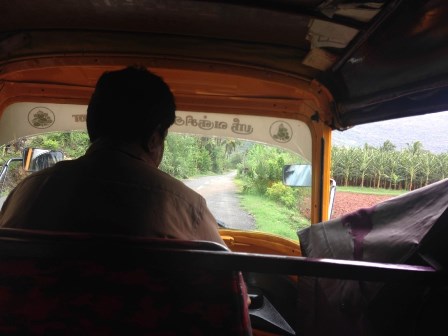
The view from the back of the first
auto rickshaw I have ever ridden in
Nonetheless, there is a lot to be said for not always having a rigid schedule. Being open to spontaneous opportunities and viewing time as a bendable concept instead of a rigid one allows you to participate in experiences you never dreamed of.

Not getting the taxi you planned on leads to an amazing trip in an autorickshaw (an open-air motorized vehicle with three wheels).

Randomly stopping to talk with a shop owner or farmer prompts an invitation to have tea or tender coconut in their home.

If I had been back in the United States, I doubt that I would have been able to say yes to all of these opportunities, or if they would have even been offered in the first place.


Roast - a dish made from a paste of rice and lenti
at one of the three Amrita University cafeterias. Delicious!
Lesson two: Hospitality

Many people in the United States would not think to invite in a stranger they have talked to for twenty minutes for tea and food, but the hospitality and kindness of many people in India run deep.

I am so grateful for the many people I met and the myriad of ways they showed little acts of kindness. Whether it be making sure I ate good food, giving me a flower or making tea, they showed that they cared.


Lesson three: Spicy vs. Hot

Puttu, a dish that consisted of rice rolled in coconut
& kdalai curry, a side dish made with beans and spices

Many of the dishes I got to try were heavy on green chili and whole black peppercorn which challenged my spice tolerance, or heat tolerance, as I should say. 

While I was there, I learned that spicy food means food rich in a variety of spices, not hot, which is the correct terminology for food that sets your mouth on fire.


Overall, I am looking forward to returning to Coimbatore sometime within the next year or two so that I can learn even more of the culture and human elephant conflict occurring there.

Thursday, August 22, 2019

Competition for Resources between Humans and Elephants: Lessons Learned from Coimbatore, India

By: Emma Dixon
July 2019 Trip to Coimbatore, India

Born and raised in Kansas, the breadbasket of the United States, where the main pests’ farmers worry about are insects, rodents and birds, I could never have imagined researching human elephant conflict.

 A coconut farm in Coimbatore, Tamil Nadu, India. It takes more than 20 years for the coconut trees to reach this height and provide consistent yield. Several trees can be damaged in during an elephant raid.

Human elephant conflict (HEC) is the competition for shared resources that is mainly a result of the fragmentation and degradation of the Asian elephant’s habitat. This can often lead to a lack of food, water and space for the elephants.

India, home to a majority of Asian elephant population, witnesses several HEC incidents annually that results in both human and elephant casualties.

An employee at the local temple describes how elephants
access the water in the tank. This footprint was left
by an elephant only few hours before we visited this temple.
The farmers in and around Coimbatore, a city in Southern India has taken the brunt of the consequences as elephants commonly raid certain crops like coconut, plantain, sorghum, maize (corn), and areca nut for food, and other cash crops trampled.

Having their crops eaten by elephants causes great economic damage to the farmers who rely on their crops to support their families.

By talking to the farmers and villagers impacted by HEC and seeing the physical barriers they have built to protect their crops and properties, my understanding of this multidimensional issue grew.

There are so many different stakeholder viewpoints, some of the farmers viewing the elephant with understanding/respect and others with fear/dislike.

Learning more of the factors that have created this problem and could lead to its solution will take time, but I know that everything I learn through this project can be used on future issues that require an interdisciplinary solution.

With the villagers who described their experiences with elephant raids.

I plan to visit this area in near future and collect more data to further my understanding of this problem.  My future research and subsequent publications will allow the scientists and policymakers working on solutions to HEC to understand the issue in greater depth.

Tuesday, August 14, 2018

Human-Elephant Conflicts: A graduate student’s experiences in India

By: A. Nicole Reed
July-August 2017 Trip to Coimbatore, India

As I stepped off the plane in Coimbatore, India, I never imagined it would change my perceptions of the world any more than it had three years ago. This would be my second time in India and I thought I knew what to expect. Everything from the food and smells to what local farmers were experiencing on their land. However, each day was a new experience filled with new information and lessons learned.

Collecting stakeholders input on human-elephant conflict
in Coimbatore, Tamil Nadu, India (August 2018)
This trip was for collecting data on people’s experiences and opinions about elephants raiding crop fields in and around Coimbatore District which will be part of my master’s thesis project. I traveled to small villages near and away from the forested areas and spoke to farmers about the conflicts they were experiencing with elephants. I visited these villages with my thesis adviser and faculty members from two colleges in Coimbatore. We interviewed about 100 farmers and other stakeholders and learned the difficulties they face to protect their crops and make a living. I also learned which mitigation efforts are more effective than others.

With students, staff and faculty at Kongunadu A&S College, Coimbatore (August 2018)
I stayed at two different colleges and met many people of different backgrounds and was fortunate to take part in a river festival with one of the college official’s families. This experience helped me better understand the culture in India and allowed me to make lasting relationships with many.


There were several opportunities for myself as well as my project to develop further, perhaps though, my biggest take away from this trip was the need for communication among professionals across disciplines as well as internationally. I was also asked to present on wildlife and land management in the United States. The exchange of information available could help us work toward solving global issues such as human-wildlife conflicts. This type of communication would allow each of us to learn from each other quickly and create better, well informed, decisions. Overall, my time spent in India was useful on several levels and allowed me to collect my data as well as learn more about the culture and history of the area. 

Saturday, April 28, 2018

Is genetically modified cotton responsible for the economic hardships faced by farmers in Central India?

William Baxter, Celia Karim, and Bryan McInerney presented their research on the genetically modified Bt cotton and its possible links to economic hardships faced by farmers in Central India. 


Protecting crops from pest infestation and diseases is one way to increase to reduce losses.  Genetically modified crops are promoted as one of the ways to increase crop yield by protecting them against pest attacks.

Bt cotton, a GM crop, was developed by introducing a toxic gene from a bacterium (Bacillus thuringiensis) into cotton plants to build resistance against the pink bollworm (Pectinophora gossypiella), a major pest of this crop.

Bt cotton was marketed in India with hopes of higher yield and lower input cost.  However, the farmers did not understand that Bt cotton was susceptible to other pests and drought, which resulted in unexpected outcome.

Their presentation focused on the introduced of Bt cotton in India and its impact on the lives of farmers in Central India.